

What Is Characteristic Of The Ethnic Makeup Of Central Asia And The Caucasus
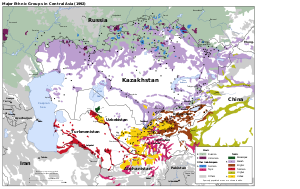
The ethnolinguistic patchwork of Central Asia in 1992
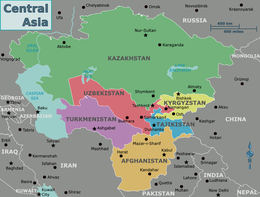
Map of the countries of Central Asia, Afghanistan (occasionally included), the Caspian Ocean, and surrounding countries
Central Asia is a diverse state with many ethnic groups, languages, religions and tribes. The nations which make upward Central Asia are five of the quondam Soviet republics: Republic of kazakhstan, Kyrgyzstan, Turkmenistan, Tajikistan, and Uzbekistan, which accept a total population of almost 72 million.[ane] [two] Transitional islamic state of afghanistan is non ever considered part of the region, merely when it is, Central Asia has a total population of nigh 122 meg (2016); Mongolia is also sometimes considered part of Central Asia due to its Fundamental Asian cultural ties and traditions, although geographically it is East Asian. [1] [two] Most central Asians belong to religions which were introduced to the surface area within the terminal 1,500 years, such as Sunni Islam, Shia Islam, Ismaili Islam, Tengriism, and Syriac Christianity.[3] Buddhism, nonetheless, was introduced to Cardinal Asia over 2,200 years agone, and Zoroastrianism, over 2,500 years ago.[four]
Indigenous groups [edit]
The below are demographic data on the ethnic groups in Central Asia[3]
| Ethnic Group | Center of population in Primal Asia | Total roughly estimated population in Primal Asia |
|---|---|---|
| Uzbek | Uzbekistan, Afghanistan, Tajikistan, Kyrgyzstan, Turkmenistan, Kazakhstan | 29,000,000 |
| Tajik | Tajikistan, Uzbekistan and Afghanistan. It includes the Pamiri people, who are officially categorized as Tajiks in Tajikistan. | 25,000,000[5] |
| Kazakh | Kazakhstan, Uzbekistan | sixteen,500,000 |
| Kyrgyz | Kyrgyzstan | 4,900,000[6] |
| Mongolians | Mongolia, Kyrgyzstan | 3,237,000 |
| Russians | Kazakhstan, Uzbekistan, Kyrgyzstan | 4,000,000 [vii] [8] [ix] [x] |
| Koreans | Kazakhstan, Uzbekistan | 500,000 [xi] |
| Ukrainian | Northern Kazakhstan | 250,000 [7] [9] [ten] |
| Turkmen | Turkmenistan, Transitional islamic state of afghanistan and Iran | 6,500,000 |
| Volga High german | Kazakhstan | 200,000[nine] [10] |
| Uyghur | Northwest Cathay, Eastern Kazakhstan, Uzbekistan, Kyrgyz republic | 13,000,000 |
| Dungan or Hui | Northwest China, Kyrgyzstan | x,500,000 |
| Bukharian Jew | Uzbekistan | one,000 |
| Tatar | Uzbekistan | 700,000 |
| Karakalpaks | Due north western Uzbekistan | 500,000 |
| Bashkirs | Kazakhstan | 30,000 |
| Meskhetian Turks | Republic of kazakhstan | 200,000 |
| Armenians | Turkmenistan, Uzbekistan | 100,000 |
| Altai | Northern Republic of kazakhstan | 10,000 |
| Pashtun | Afghanistan, Northwest Pakistan and Razavi Khorasan in Islamic republic of iran[12] | 12,500,000 |
| Hazara | Primal Afghanistan | 3,500,000 |
| Aimak | Central and Northwest Afghanistan | i,500,000 |
| Nuristani | Far eastern and northern Afghanistan | 200,000+ |
| Belarusians | Northern Republic of kazakhstan | 100,000-200,000 [10] |
| Romanians | Republic of kazakhstan | 20,000 |
| Greeks | Kazakhstan | 30,000 |
| Mordvins | Kazakhstan | twenty,000 |
| Moldovans | Kazakhstan | 25,000 |
| Chechens | Republic of kazakhstan | forty,000 |
| Poles | Northern Republic of kazakhstan | fifty,000-100,000 |
| Azeri | Republic of kazakhstan and Turkmenistan | 100,000 |
| Chovash | Northern Kazakhstan | 35,000 |
Genetic history [edit]
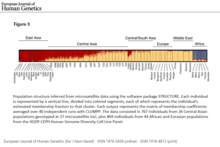
Total genome analysis of Cardinal Asian ethnic groups reveals predominantly E-Eurasian (East Asian-related) beginnings.
The ancestry of mod Key Asian populations is significantly derived from the Indo-Iranian and Turkic expansions. Most modern populations can be aligned with either Indo-Iranian or Turkic descent, with ancestry corresponding well with ethnic boundaries.[13]
Archaeogenetic studies on the remains from Iron Age Pazyryk culture burials suggest that subsequently the end of the Indo-Iranian (Scythian) expansion, beginning in c. the 7th century BC, at that place was a gradual east-to-west influx of Due east Eurasian admixture to the Western steppes.[14]
Populations of farmers and nomadic pastoralists coexisted in Central Asia since the Chalcolithic (4th millennium BC). The two groups differ markedly in descent structure, as pastoralists are organized in exogamous patrilineal clan structures, while farmers are organized in extended families practicing endogamy (cousin marriage). Every bit a upshot, pastoralists accept a significantly reduced diversity in patrilineal descent (Y-chromosome) compared to farmers.[15]

The Turkic expansion spreaded Turkic languages forth with 'Northeast Asian' ancestry westwards, throughout Central Asia, too as parts of Europe.[sixteen]
Bronze Age Central Asia was largely populated by West-Eurasian Iranian-speaking peoples, also as a minority of East Asian-related Paleosiberian peoples from further Eastward. Since the Iron Age, significant migrations from Eastern asia and Eastern Siberia took place, mostly associated with the expansion of Turkic peoples from a region corresponding to modern day Mongolia, transforming Central Asia from a region with largely Due west-Eurasian ancestry, to a region with primarily East Asian ancestry.[17]
Organized religion [edit]
| Religion[3] | Approximate population | Eye of population |
|---|---|---|
| Sunni Islam | 103,000,000[18] [19] [20] [21] [22] [23] | South and East of region: Tajikistan, Turkmenistan, Kyrgyzstan, Uzbekistan, Afghanistan, Eastern Xinjiang and Southern Republic of kazakhstan.(near dense in Transitional islamic state of afghanistan and Uzbekistan) |
| Buddhism | 9,084,000[24] [25] [26] [27] [28] | 500,000 in Russia, viii.44 million in Xinjiang, 140,000 people in Kazakhstan and Afghanistan; (Mongols, Koreans, Daur, Mongour, Tungusic peoples, Tibetans, Tuvans, Yugur) |
| Shia Islam | 4,000,000 | Hazaras, Central Afghanistan |
| Eastern Christianity | four,000,000 | Mainly in northern Kazakhstan, significant communities are as well located in the other 4 Soviet republics in the region. |
| Atheism and Irreligion | 2,500,000+ | Throughout the region |
| Western Christianity | 510,000 | Kazakhstan |
| Judaism | 27,500 | Uzbekistan |
| Zoroastrianism | 10,000 | Historically Afghanistan |
See also [edit]
- Indo-Aryan migration hypothesis
- Turkic migration
- History of the Jews in Central Asia
References [edit]
- ^ a b ""Globe Population prospects – Population division"". population.united nations.org. Un Department of Economic and Social Diplomacy, Population Partition. Retrieved November ix, 2019.
- ^ a b ""Overall total population" – World Population Prospects: The 2019 Revision" (xslx). population.united nations.org (custom information acquired via website). United Nations Department of Economic and Social Affairs, Population Sectionalisation. Retrieved Nov 9, 2019.
- ^ a b c "The World Factbook — Central Intelligence Agency". Cia.gov . Retrieved 11 January 2018.
- ^ "Archived copy". Archived from the original on 2009-09-25. Retrieved 2010-02-18 .
{{cite web}}: CS1 maint: archived copy every bit title (link) - ^ Foltz, Richard (2019). A History of the Tajiks: Iranians of the East. Bloomsbury Publishing. p. i. ISBN978-1784539559.
- ^ "Total population by nationality (assessment at the beginning of the year, people)". Agency of Statistics of Kyrgyzstan. 2021.
- ^ a b "Archived copy". Archived from the original on 2010-03-24. Retrieved 2009-01-02 .
{{cite web}}: CS1 maint: archived re-create as championship (link) - ^ "Archived re-create". Archived from the original on 2011-08-25. Retrieved 2012-07-22 .
{{cite spider web}}: CS1 maint: archived copy as title (link) - ^ a b c "Archived re-create" (PDF). Archived from the original (PDF) on 2009-02-06. Retrieved 2012-01-17 .
{{cite web}}: CS1 maint: archived copy every bit title (link) - ^ a b c d "Archived copy". Archived from the original on 2010-03-xvi. Retrieved 2013-05-02 .
{{cite web}}: CS1 maint: archived re-create as championship (link) - ^ Alekseenko, Aleksandr Nikolaevich (2000). Республика в зеркале переписей населения [Republic in the Mirror of the Population Censuses] (PDF). Population and Society: Newsletter of the Centre for Demography and Human being Ecology (in Russian). Plant of Economic Forecasting of the Russian Academy of Sciences (47): 58–62. Retrieved 18 March 2019.
- ^ "Ethnologue report for Southern Pashto: Iran (1993)". SIL International. Ethnologue: Languages of the World. Retrieved 5 May 2012.
- ^ Heyer, Evelyne; Balaresque, Patricia; Jobling, Marker A.; Quintana-Murci, Lluis; Chaix, Raphaelle; Segurel, Laure; Aldashev, Almaz; Hegay, Tanya (2009). "Genetic variety and the emergence of ethnic groups in Central Asia". BMC Genetics. 10: 49. doi:10.1186/1471-2156-10-49. PMC2745423. PMID 19723301.
Our analysis of uniparental markers highlights in Central Asia the differences between Turkic and Indo-Iranian populations in their sex-specific differentiation and shows adept congruence with anthropological information.
- ^ González-Ruiz, Mercedes; Santos, Cristina; Jordana, Xavier; Simón, Marc; Lalueza-Trick, Carles; Gigli, Elena; Aluja, Maria Pilar; Malgosa, Assumpció (2012). "Tracing the Origin of the East-W Population Admixture in the Altai Region (Primal Asia)". PLOS 1. 7 (11): e48904. Bibcode:2012PLoSO...748904G. doi:10.1371/journal.pone.0048904. PMC3494716. PMID 23152818.
- ^ Chaix, Raphaëlle; Quintana-Murci, Lluís; Hegay, Tatyana; Hammer, Michael F.; Mobasher, Zahra; Austerlitz, Frédéric; Heyer, Evelyne (2007). "From Social to Genetic Structures in Central Asia". Electric current Biology. 17 (i): 43–48. doi:10.1016/j.cub.2006.x.058. PMID 17208185. S2CID 16405468.
- ^ Uchiyama, Junzo; Gillam, J. Christopher; Savelyev, Alexander; Ning, Chao (2020). "Populations dynamics in Northern Eurasian forests: a long-term perspective from Northeast Asia". Evolutionary Homo Sciences. two. doi:ten.1017/ehs.2020.11. ISSN 2513-843X.
- ^ Damgaard, Peter de Barros; Marchi, Nina; Rasmussen, Simon; Peyrot, Michaël; Renaud, Gabriel; Korneliussen, Thorfinn; Moreno-Mayar, J. Víctor; Pedersen, Mikkel Winther; Goldberg, Amy; Usmanova, Emma; Baimukhanov, Nurbol (May 2018). "137 ancient homo genomes from across the Eurasian steppes". Nature. 557 (7705): 369–374. doi:10.1038/s41586-018-0094-two. ISSN 1476-4687.
These historical events transformed the Eurasian steppes from being inhabited past Indo-European speakers of largely West Eurasian ancestry to the mostly Turkic-speaking groups of the present mean solar day, who are primarily of East Asian beginnings.
- ^ Min Junqing. The Nowadays Situation and Characteristics of Contemporary Islam in China. JISMOR, viii. 2010 Islam by province, folio 29. Data from: Yang Zongde, Study on Current Muslim Population in Cathay, Jinan Muslim, 2, 2010.
- ^ Religious Composition by Country, 2010–2050 | Pew Inquiry Middle. Pewforum.org (2 April 2015). Retrieved on 2017-01-20.
- ^ "MAPPING THE GLOBAL MUSLIM POPULATION : A Study on the Size and Distribution of the Globe's Muslim Population" (PDF). Pewforum.org. October 2009. Retrieved 11 January 2018.
- ^ Mapping the Global Muslim Population. A Report on the Size and Distribution of the World'southward Muslim Population Archived 2011-08-21 at WebCite. Pew Forum on Religion & Public Life (October 2009)
- ^ "Religious Limerick by Country, 2010-2050". Pewforum.org. two April 2015. Retrieved 11 January 2018.
- ^ "The Globe Factbook — Central Intelligence Agency". Cia.gov . Retrieved 11 January 2018.
- ^ "Religious Intelligence - State Profile: Republic of kazakhstan (Commonwealth of Kazakhstan)". 30 September 2007. Archived from the original on 30 September 2007. Retrieved 11 January 2018.
- ^ "Religious Intelligence - State Contour: Kyrgyzstan (Kyrgyz republic)". six Apr 2008. Archived from the original on half dozen April 2008. Retrieved xi January 2018.
- ^ Religious Freedom Page Archived August 29, 2006, at the Wayback Automobile
- ^ "Turkmenistan". State.gov . Retrieved xi January 2018.
- ^ "The results of the national population census in 2009". Bureau of Statistics of the Republic of Republic of kazakhstan. 12 November 2010. Archived from the original on 22 July 2011. Retrieved 21 January 2010.
- https://www.researchgate.internet/profile/Chuan-Chao_Wang
- https://synaptic.bio/publications/8629
- Wang, Chuan-Chao; Robbeets, Martine (April 2020). "The homeland of Proto-Tungusic inferred from contemporary words and ancient genomes". Evolutionary Human Sciences. 2: 1–12. doi:10.1017/ehs.2020.viii.
- Wen, Shao-Qing; Sunday, Chang; Song, Dan-Lu; Huang, Yun-Zhi (April 2020). "Y-chromosome prove confirmed the Kerei-Abakh origin of Aksay Kazakhs". Journal of Man Genetics. 65 (9): 797–803. doi:ten.1038/s10038-020-0759-1. PMID 32313196. S2CID 215819594.
- Zhao, Jing; Wurigemule, Wurigemule; Sun, Jin; Xia, Ziyang (October 2020). "Genetic substructure and admixture of Mongolians and Kazakhs inferred from genome-wide assortment genotyping". Annals of Human Biological science. 47 (seven–8): 620–628. doi:x.1080/03014460.2020.1837952. PMID 33059477. S2CID 222839155.
- Zerjal, Tatiana; Wells, Spencer; Yuldasheva, Nadira Yusupovna; Ruzibakiev, Ruslan (October 2002). "A Genetic Landscape Reshaped by Recent Events: Y-Chromosomal Insights into Primal Asia". The American Journal of Human Genetics. PubMed. 71 (3): 466–82. doi:ten.1086/342096. PMC419996. PMID 12145751.
- Yamamoto, Toshimichi; Senda, Tomoki; Horiba, Daiki; Sakuma, Masayoshi (December 2013). "Y-chromosome lineage in five regional Mongolian populations". Forensic Science International: Genetics Supplement Series. 4 (1): e260-e261. doi:10.1016/j.fsigss.2013.x.133.
Source: https://en.wikipedia.org/wiki/Demographics_of_Central_Asia
Posted by: murphyhatiorth.blogspot.com
0 Response to "What Is Characteristic Of The Ethnic Makeup Of Central Asia And The Caucasus"
Post a Comment